Dishes on the heritage lists
Rather than a list of favourites, this is the list Guangzhou keeps itself: dishes and techniques on China’s national heritage list, Guangdong’s provincial list and the city’s own lists of 2022 and 2026. Order by these names and you are ordering the city’s classics.
| Dish | What it is | Listed |
|---|---|---|
| Herbal tea 凉茶 | Bitter brewed herbal drinks sold by the cup | National list, 2006 |
| Shahe rice noodles 沙河粉 | Flat rice noodles, stir-fried with beef or served in soup | National list, 2021 |
| Rice noodle rolls 肠粉 | Steamed rice sheets rolled around a filling, with soy sauce | Guangzhou list, 2022; cloth-steamed rolls added 2026 |
| Siu mai 广式烧卖 | Open-topped pork and shrimp dumplings | Guangzhou list, 2022 |
| Wonton noodles 云吞面 | Thin egg noodles with shrimp wontons in broth | Guangzhou list, 2022 |
| White-cut chicken 白切鸡 | Poached chicken served cool with ginger and spring onion | Guangzhou list, 2022 |
| Beef offal 牛杂 | Slow-braised beef offal, often sold at street stalls | Guangzhou list, 2022 |
| Cantonese desserts 广式甜品 | Sweet soups and puddings (tong sui) | Guangzhou list, 2022 |
| Congee, including boat congee 广式粥品 · 艇仔粥 | Rice porridge; boat congee adds fish, peanuts and crunchy toppings | Guangzhou list, 2026 |
| Dim sum, including char siu bao 广式点心 · 叉烧包 | Small steamed, baked and fried items eaten with tea | Guangzhou list, extended 2026 |
| Roast goose and suckling pig 烧鹅 · 乳猪 | Roast meats (siu mei), sold by weight or by the plate | Guangzhou list, extended 2026 |
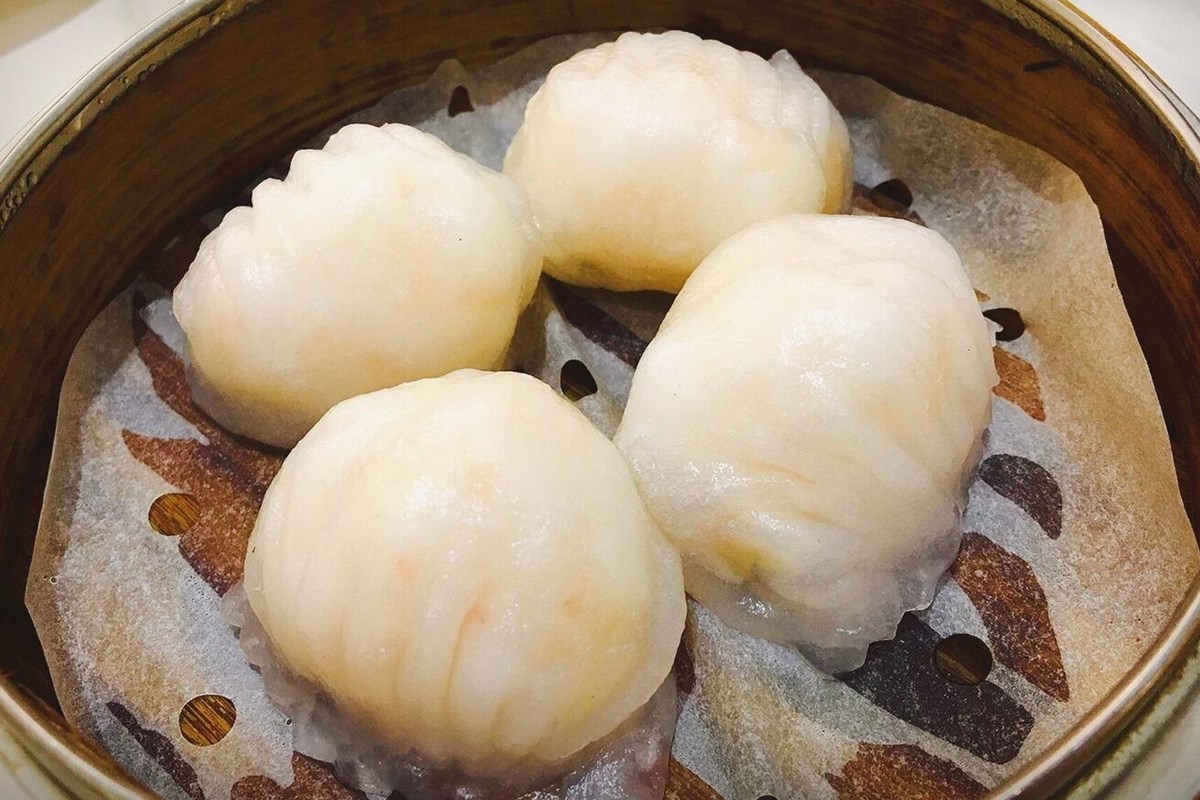
Har gow, the shrimp dumpling in the photo, is not named on any list we found; the 2026 city list covers Cantonese dim sum as a craft. Show the Chinese names to staff if the menu has no English.
Yum cha: how it works
Drinking tea with dim sum, the Cantonese teahouse habit, went onto Guangdong’s provincial heritage list in 2022. The old shorthand is yi zhong liang jian, “one pot, two pieces”: a pot of tea and two plates of dim sum.
- Say thanks without words. When someone pours your tea, tap the table lightly with two bent fingers.
- Ask for hot water with the lid. When the pot is empty, lift the lid and leave it resting on the rim; staff will come and refill it.
- Expect a tea fee. Many teahouses charge per person for tea; the price must be shown before you order (next section).
The 2026 morning-tea rules
Guangzhou’s morning-tea regulation took effect on 1 May 2026. Three parts of it matter at the table:
- Teahouses must tell you whether their dim sum is made on site in the traditional way or made another way.
- Traditionally made dim sum must be eaten within 24 hours of being made.
- Every charge, including the tea fee, must be priced openly, and a teahouse that charges a tea fee must serve tea for it.
Certified traditional shops
The same regulation set up a certificate for traditional morning-tea shops, assessed by the city’s market regulator with the culture and commerce bureaus. The first list came out on 21 Sept 2026: 197 shops applied and 40 passed. Three restaurant groups were certified at head-office level, which requires every one of their branches in Guangzhou to meet the standard:
- Guangzhou Restaurant (广州酒家)
- Taotaoju (陶陶居)
- Diandude (点都德)
Certified shops receive a certificate and a plaque from the city, and calling a shop certified without passing is an offence. The plaque on the wall is the thing to look for; the full list of 40 shops was not published with the announcement.
Food streets by metro
Guangzhou’s official English site sends visitors to these four streets for everyday local food. Each is a short walk from a metro exit.
Tongfu Road 同福路
Haizhu district. Built in 1926: about 2 km of arcaded street with soup, snack and dessert shops.
Metro: Line 2 Shi'ergong (2nd Workers' Cultural Palace) exit D; Line 8 Tongfuxi exit A
Dezheng Middle Road and Wenming Road 德政中路 · 文明路
Yuexiu district. Wonton noodles, rice noodles, roast meats and soups; dessert shops cluster where the two roads meet.
Metro: Line 1 Peasant Movement Institute, exit A or B
Longjin Road 龙津路
Liwan district. Nearly 3 km of arcaded street near the Chen Clan hall: teahouses, claypot rice, roast meats, congee.
Metro: Lines 1 and 8 Chen Clan Academy, exit B or D; Line 1 Changshoulu, exit D or E
Xihua Road 西华路
Liwan district. Small shops, many without big signs, known for queues.
Metro: Line 1 Ximenkou exit D; Line 8 Caihongqiao exit A, or Chen Clan Academy exit F
Longjin Road is the one to pair with a sight: it runs past the Chen Clan Ancestral Hall. For the old shopping streets, see Beijing Road and Shangxiajiu.
Paying
Since 2024 Guangzhou has pushed card terminals that accept overseas bank cards into restaurants and other places visitors use, with an acceptance sticker at the till; in April 2024 the city put coverage in its key visitor areas at 65% of merchants. That leaves about one in three without a card terminal, so look for the sticker before you order.
Frequently asked questions
What is Cantonese food?
The cooking of Guangdong, one of the eight great cuisines of China. Guangzhou itself names soup, tea, dim sum and late-night eating as the core of its food culture.
What are the most famous Cantonese dishes?
Guangzhou’s heritage lists name Shahe rice noodles and herbal tea at national level, and rice noodle rolls, siu mai, wonton noodles, white-cut chicken, roast goose, boat congee and dim sum such as char siu bao at city level.
What does “yi zhong liang jian” mean?
“One pot, two pieces”: a pot of tea and two plates of dim sum, the old shorthand for a morning at the teahouse.
Why do people tap the table at dim sum?
Tapping two bent fingers on the table is a silent thank-you when someone pours your tea. To ask for more hot water, lift the teapot lid and leave it resting on the rim.
Do Guangzhou teahouses charge for tea?
Many charge a per-person tea fee. Since 1 May 2026 Guangzhou’s morning-tea regulation requires every charge, including the tea fee, to be priced openly, and a teahouse that charges it must actually serve tea.
What is a certified traditional morning-tea shop?
A teahouse that passed Guangzhou’s new assessment. The first list, published on 21 Sept 2026, has 40 shops and three restaurant groups; certified shops display a plaque issued by the city.
Sources
Every fact on this page is checked against the notices below. Last checked 27 Nov 2026.
- About Guangzhou: food culture — Guangzhou International (City Government)
- 凉茶 —— 国务院 2006 年批准列入第一批国家级非物质文化遗产名录 — Guangzhou Municipal Government
- 米粉制作技艺(沙河粉传统制作技艺)—— 国家级非遗第五批,Ⅷ-277 — China Intangible Cultural Heritage Network
- 广东省第八批省级非遗名录(含广府饮茶习俗) — Guangzhou Municipal Government, 21 May 2022
- 广州市第八批市级非物质文化遗产代表性项目名录(穗府函〔2022〕213号) — Guangzhou Municipal Government, 20 Oct 2022
- 广州市第九批市级非物质文化遗产代表性项目名录(穗府函〔2026〕122号) — Guangzhou Municipal Government, 18 May 2026
- 一盅两件、叩谢与揭盖续水 —— 广府饮茶习俗 — Guangzhou Municipal Government (from Guangzhou Daily), 21 Sept 2022
- 《广州早茶传承保护规定》5月1日起施行 — Guangming Online (from Guangzhou Daily), 2 Apr 2026
- 首批「广州早茶传统店」名单发布 — Guangzhou Municipal Government (from Guangzhou Daily), 22 Sept 2026
- Fair Breaks: Where to eat like a local in Guangzhou — Guangzhou International (City Government), 14 Apr 2026
- 广州市优化支付服务工作方案(穗府函〔2024〕46号):重点领域受理外卡 — Guangzhou Municipal Government, 30 Mar 2024
- 65% of merchants in key foreign-facing areas accept overseas cards — Guangzhou International (City Government), 7 Apr 2024
Not confirmed:
- Har gow, double-skin milk and Cantonese cooking as named entries on a heritage list (har gow may sit under the Cantonese dim sum entry, which does not name it).
- The full list of the 40 certified traditional morning-tea shops; we found only the announcement.
- The text of the morning-tea regulation on the legislature's own site; we used the official interview published in the press.
- A Guangzhou notice since 2024 specifically about overseas cards in restaurants.
We recheck these facts against the notices above; the date at the top of the page is the last time we did.